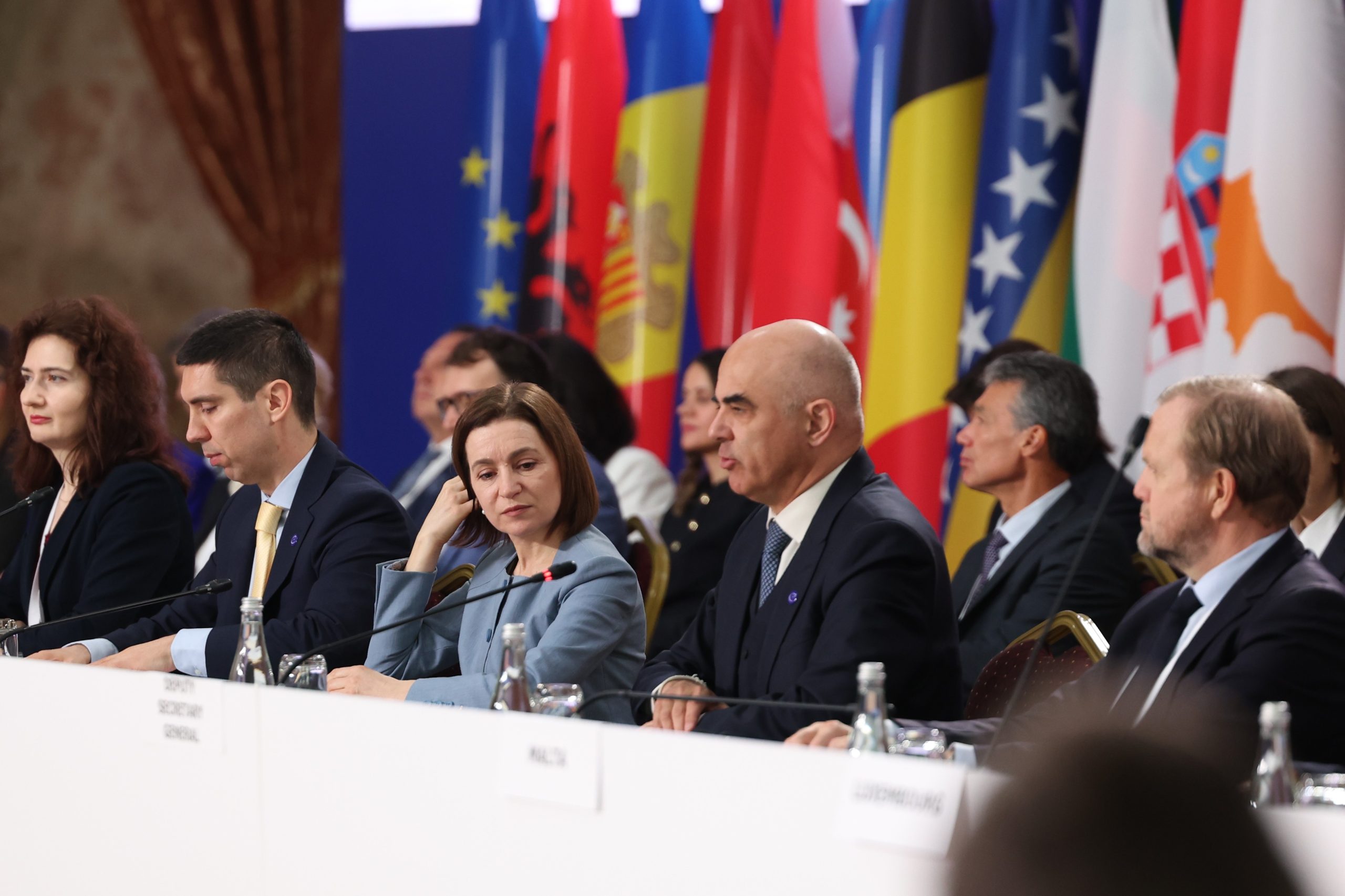
Member states of the Council of Europe, including the UK, France and Poland, have unanimously agreed to clarify how the European Convention on Human Rights (ECHR) should be interpreted by national authorities in migrant cases.
It’s an attempt to give governments more power to act to deport migrants they see as dangerous or unwelcome without undermining fundamental rights.
Ultimately, the Council of Europe hopes to stem the flow of criticism of the convention and the European Court of Human Rights, particularly in the UK, Italy and Denmark – but without changing the convention itself or tying the hands of judges.
What does the ‘declaration’ mean?
The “political declaration” was signed by all 46 members at a meeting of foreign ministers in Moldova on Friday morning.
It “mean[s] that countries can take action on illegal migration, and strong action, at the same time as upholding international law and standards,” said UK Foreign Secretary, Yvette Cooper.

“We have worked over many months with many countries and partners across Europe as part of our determined diplomacy because for us in the UK, this is an example of how the partnerships that we build abroad, make us stronger at home.”
ECHR concerns in the UK, Denmark
The ECHR has become a lightning rod for concerns about mass migration and a feeling that governments are powerless to act.
And that’s not just in the UK.
The Danish government has complained that the ECHR was preventing it from expelling migrants who committed a criminal act if they had family in Denmark.
Council of Europe officials denied that this was the case, but the new text is more explicit on what governments can do.
Under the declaration, ministers agreed that national authorities will be able to counter “respect for private and family life” against the “significant weight” of factors including “national security, public safety or the economic well-being of the country, the prevention of disorder or crime, the protection of health or morals, or the protection of the rights and freedoms of others”.
National security ‘should not be invoked with vague meanings’
There are those who are nervous about where such a broad set of exceptions could lead.
Amnesty International has warned that concepts like national security “should not be invoked with vague, blanket or indeterminate purported meanings to justify restrictions on Convention rights, given the risk of arbitrariness.”
But the Secretary General of the Council of Europe has been gung-ho in trying to meet member states’ concerns half way.
“The question is about the world we are living in today and what interpretation, what does it mean for the member states, for the countries. And it is, first of all, a political discussion,” Alain Berset told Channel 4 News last month.
Migrant deportations
While it will continue to be illegal to expel someone to a country where they may face torture or the death penalty, the new interpretation of Article 3 of the convention, in theory, will make it easier to deport migrants to a country where prisons are maybe crowded or decrepit, but nonetheless considered “sufficient”.
The declaration also gives a helping hand to countries like the UK and Italy which have toyed with exporting migrants to somewhere out of sight.

For so-called “migrant hubs” in Rwanda or Albania, there is now new wiggle room:
“States Parties may establish their own immigration policies, which may include co-operation with third countries, provided that they continue to fulfil their Convention obligations,” it sets out.
In other words, the ECHR won’t stop them so long as minimum standards are written into such agreements.
All these changes are about how the ECHR is interpreted by national authorities and domestic courts. It doesn’t change the convention itself, nor bind the hands of judges who sit in the European Court of Human Rights in Strasbourg.
One senior official closely involved in drafting the declaration admitted that he had “no idea” if it would alter judgements in the international court. But migrant cases making it that far are quite rare.
Only around one in 1,000 cases presented before the European Court of Human Rights have resulted in judges concluding a violation related to migration, according to the Council of Europe.
The case in Britain
The Council hopes the declaration will be enough to defuse the political pressure on the ECHR. But they are nervous about how the changes will go down in Britain.
Both Reform and the Conservatives have pledged to leave the ECHR and the Council of Europe if they get into government.
But Berset rejects any suggestion that this could be another Brexit
“It is really impossible just to compare Brexit and leaving the Convention,” he told Channel 4 News.
The “European Union is a political project…the European Convention of Human Rights is protecting the rights of individuals. [It’s] much better to have this conversation and to see what we need to adapt, what we need to discuss.”
Playing out in practice
The real test of the declaration will be how it plays out in practice.
An estimated 46,000 people entered the UK illegally last year. Close to 90 per cent of those detected arrive on small boats across the English Channel, according to the Home Office.
Most go on to apply for asylum in the UK.
In the King’s Speech this week, the government pledged to make changes to domestic law on the interpretation of Article 8 of the convention (right to a family life) to make it easier to return migrants. It will also, in effect, enact the agreement in Moldova.
“The declaration is expected to help courts interpret how the ECHR is applied, ensuring that serious criminals are not able to exploit the system to frustrate their deportation and extradition, and ensuring that family rights under Article 8 are properly balanced against the public interest – including the ability of countries to be able to deport foreign criminals and address national security threats,” the foreign office said.
Undoubtedly, that will ultimately be something that will be put to the test in the courts.